.webp)
The functionality and benefits of data loggers in the transport and storage of goods
Introduction
Data loggers are indispensable devices for monitoring and recording environmental conditions such as temperature, humidity and vibration. They play a crucial role in the transport and storage of goods to ensure product quality and safety. In this article, we explain how data loggers work and the benefits they offer in these processes.
How data loggers work
Sensors and data acquisition
Data loggers are equipped with highly sensitive sensors that continuously measure environmental conditions such as Temperature and humidity. These sensors capture precise data that is essential for the quality assurance of goods.
Data acquisition and storage
The collected data is recorded at regular intervals in the data logger’s internal memory or transmitted in real time. Modern data loggers have large storage capacities, enabling long-term data collection.
Reliable power supply
Data loggers are usually powered by long-life batteries to ensure continuous operation. Some models offer options for an external power supply.
Data transmission and analysis
The recorded data can be transmitted via USB, Bluetooth, Wi-Fi or mobile networks. Specialised software enables detailed analysis and visualisation of the recorded data.
Advantages of data loggers in transport and storage
Quality assurance for sensitive goods
Data loggers continuously monitor environmental conditions and immediately detect any deviations that could compromise the quality of food, medicines or chemical products. This is crucial for maintaining optimal storage and transport conditions.
Prevention of damage
Data loggers help prevent damage to goods by detecting unfavourable environmental conditions at an early stage. Problems such as excessive heat, humidity or vibrations can be identified and rectified in good time.
Documentation and proof of regulatory compliance
The recorded data serves as evidence of compliance with the prescribed storage and transport conditions. This is particularly important in regulated sectors such as the food and pharmaceutical industries.
Increased efficiency and process optimisation
By analysing the data, weaknesses in transport and storage processes can be identified and optimised. This leads to improved efficiency and cost savings.
Increased customer satisfaction
Data loggers help to ensure product quality, which increases customer satisfaction. Transparent information about conditions during transport and storage strengthens customer confidence.

- GDP-compliant reusable temperature logger
- Automatically generated PDF analyses
- Status indication on the display

- Precise temperature monitoring
- Extreme low temperature capability down to -90°C
- Simple operation
- Continuous data recording
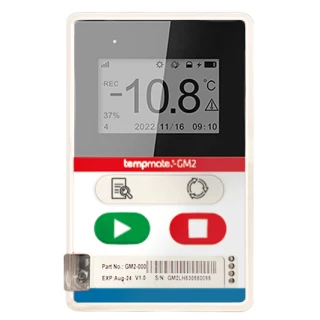

- Temperature range: -30°C to +70°C (can be extended to -40°C to +80°C and -200°C to +100°C with optional external sensors)
- Battery life: Up to 120 days with rechargeable battery
- Data connection: Worldwide 4G connectivity with automatic switch to 2G
- Memory: Local memory for up to 50,000 measured values, unlimited storage space on the tempmate cloud

Disposable temperature indicator
- Waterproof and food-safe
- Intelligent LED status monitoring
- Cost-effective and reliable
- Available for different temperature ranges

- Disposable temperature data logger
- -30°C to +70°C
- up to 180 days recording time


- Disposable temperature data logger
- -30°C to +70°C
- up to 180 days recording time at 10 min. measuring interval
(other options on request) - Multifunction LCD display
- PDF report
- EN 12830, CE, RoHS
- Calibration certificate
- Dimensions: 93 x 47 x 8 mm

- Disposable temperature data logger
- Temperature and relative humidity
- -30°C to +70°C
- up to 180 days recording time at 10 min. measuring interval
- (other options on request)
- Multifunction LCD display
- PDF report
- EN 12830, CE, RoHS
- Calibration certificate
- Dimensions: 93 x 47 x 8 mm
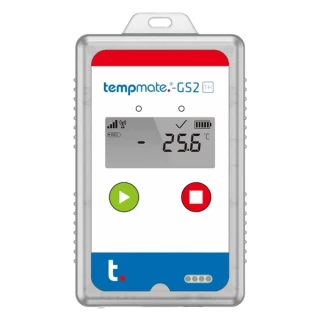
- Comprehensive transport monitoring: Records temperature, relative humidity, light, shock, tilt and the cellular-network-based location
- Real-time data transmission: Transfers measurement data via 4G LTE Cat 1 with 2G fallback to the tempmate.®-Cloud and additionally stores it locally
- Up to 120 days of recording: Applies to the lithium version with a 10-minute logging interval and a 240-minute transmission interval
- Local report output via USB 2.0: Stored data and reports can also be accessed locally through the USB interface
- Configurable monitoring: Logging and transmission intervals as well as alarm limits can be adjusted to suit the transport application
Important information for shipments to China: The location function of the tempmate.®-GS2 V2 cannot be used reliably on mainland China. The logger is not a GPS logger. Its location is determined via the cellular network using LBS (Location Based Services). Due to limitations in processing the location data, the position shown on the cloud map in China may be missing, outdated or incorrect.


